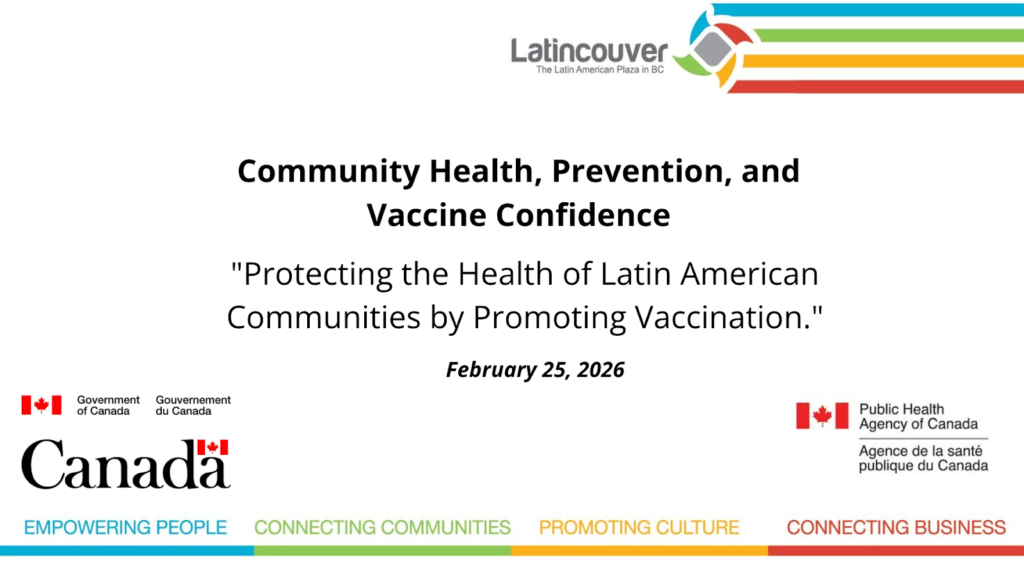
Key Insights from Latincouver’s Immunization Roundtable
Strengthening community health requires more than access to healthcare services, it also requires trust, accessible information, and collaboration between healthcare professionals, community organizations, and local leaders.
To foster dialogue around these important topics, Latincouver hosted a roundtable discussion on Community Health, Prevention, and Vaccine Confidence, bringing together healthcare professionals, researchers, and community advocates to discuss current public health challenges and opportunities related to vaccination.
The discussion explored several key themes, including HPV prevention, measles outbreaks, and the growing impact of vaccine misinformation on communities. Throughout the conversation, panelists emphasized that improving vaccine confidence requires a combination of education, culturally responsive outreach, and strong partnerships between public health institutions and community-based organizations.
By creating a space for open discussion and knowledge sharing, the roundtable aimed to strengthen community understanding of vaccination and support more inclusive approaches to public health engagement.
A Collaborative Conversation on Public Health
The panel brought together experts from public health, academia, community organizations, and diplomatic institutions, each offering unique perspectives on vaccination and community health.
Director Duberlis Ramos, from the Hispanic Development Council in Toronto, shared insights from his work supporting Hispanic communities through culturally responsive education and prevention initiatives.
Dr. Jorge Filmus, professor in the Department of Medical Biophysics at the University of Toronto, contributed a scientific and research-based perspective on vaccination and public health communication.
Dr. Irene Santos, a health promotion professional at the Umbrella Multicultural Health Co-op, discussed her experience working with diverse communities and addressing linguistic and cultural barriers to healthcare access.
Dr. Meena Dawar, Medical Health Officer at Vancouver Coastal Health, provided a public health leadership perspective, focusing on immunization programs and disease prevention strategies in British Columbia.
Dr. César Ávila, a family physician trained in Colombia and Spain, shared his experience working with Latin American communities and promoting immunization strategies among vulnerable populations.
Finally, Antonio Arriaga Valdez, Honorary Consul General of Costa Rica in Vancouver, highlighted the role that diplomatic and community institutions can play in sharing health information with immigrant communities.
Together the panelists discussed how different sectors, including healthcare systems, academic institutions, and community organizations, can collaborate to improve vaccination awareness and access.
Their perspectives highlighted the importance of interdisciplinary approaches to public health, where research, medical expertise, and community engagement work together to address complex health challenges.
Addressing the Risk of HPV Through Prevention and Education
The discussion began with a focus on Human Papillomavirus (HPV) and the role that vaccination programs play in preventing HPV-related cancers.
Panelists explained that HPV is one of the most common viral infections globally and that vaccination remains one of the most effective strategies for preventing several types of cancers associated with the virus, including cervical cancer. In Canada, HPV vaccination programs have evolved significantly over time as new scientific evidence has emerged.
Public health experts described how school-based vaccination programs have become a central component of prevention strategies. By offering vaccines in school settings, health authorities can reach young people before they are exposed to the virus, significantly increasing the effectiveness of the program.
However, panelists emphasized that vaccination programs are not only about providing vaccines, they also require strong communication and community engagement. Families often have questions when new vaccines are introduced, and public health professionals must ensure that accurate and accessible information is available.
The panel also discussed how conversations around HPV can sometimes be sensitive, particularly in communities where discussions about sexual health may be more difficult. For this reason, culturally appropriate education and multilingual outreach were highlighted as essential strategies for improving awareness and building trust.
Measles Outbreaks and the Importance of Maintaining High Vaccination Rates
Another key topic of the roundtable was the re-emergence of measles outbreaks in different parts of the world.
Panelists explained that measles is one of the most contagious viruses known in public health. Because of its high transmissibility, preventing outbreaks requires very high levels of vaccination coverage across populations.
Although Canada achieved measles elimination status in the past, panelists noted that international travel and declining vaccination rates in certain regions have contributed to new outbreaks in recent years. Even small gaps in immunization coverage can allow the virus to spread quickly within communities.
Public health experts emphasized that maintaining high vaccination coverage is essential not only to protect individuals but also to safeguard the broader community through herd immunity. When vaccination rates drop below certain thresholds, vulnerable populations, including infants and individuals with weakened immune systems, may face greater health risks.
The panel also discussed the importance of maintaining strong surveillance systems, community education initiatives, and continued investment in vaccination programs to prevent the resurgence of vaccine-preventable diseases.
Understanding the Impact of Vaccine Misinformation
The roundtable also addressed the increasing influence of vaccine misinformation, particularly through digital platforms and social media.
Panelists noted that misinformation can spread rapidly online, often reaching communities faster than verified scientific information. This can create confusion and uncertainty among individuals who are trying to make informed decisions about their health.
Healthcare professionals emphasized that misinformation is not only a communication challenge but also a public health concern. When inaccurate information circulates widely, it can contribute to vaccine hesitancy and reduce overall vaccination coverage.
Addressing misinformation requires proactive engagement from healthcare providers, researchers, and community leaders. Panelists highlighted the importance of creating opportunities for open dialogue, where individuals can ask questions and receive clear, evidence-based answers.
Providing reliable information in culturally relevant and accessible formats, particularly through trusted community organizations, was identified as a key strategy for countering misinformation and supporting informed decision-making.
The Role of Community Organizations in Building Trust
Throughout the discussion, panelists highlighted the important role that community-based organizations play in strengthening public health initiatives.
Organizations that work directly with immigrant and multicultural communities often serve as trusted intermediaries between healthcare systems and the populations they support. These organizations understand the cultural, linguistic, and social contexts that shape how individuals access healthcare services and health information.
Community organizations can help ensure that public health messages are communicated in ways that resonate with diverse audiences. This includes providing information in multiple languages, addressing culturally specific concerns, and creating spaces where individuals feel comfortable discussing health topics.
Panelists also emphasized that health outcomes are influenced by broader social factors, including access to healthcare services, economic stability, and trust in institutions. By taking these factors into account, public health initiatives can become more inclusive and effective.
Strengthening Community Health Through Collaboration
As the roundtable concluded, participants emphasized that improving vaccine confidence and strengthening public health requires sustained collaboration across sectors.
Healthcare institutions, researchers, community leaders, and policymakers all play important roles in ensuring that communities have access to reliable health information and preventive healthcare services.
Education, trust-building, and culturally responsive outreach were identified as key pillars for promoting vaccination awareness and supporting informed decision-making. Creating spaces where experts and community members can engage in open dialogue is an important step toward building stronger relationships between communities and healthcare systems.
Events like this roundtable demonstrate how collaborative approaches can help address complex public health challenges and promote healthier, more resilient communities.
About the Program
This roundtable was part of Latincouver’s ongoing efforts to promote community health, prevention, and vaccine confidence among diverse communities across Canada.
Through partnerships with healthcare professionals, community organizations, and institutional partners, Latincouver works to improve access to accurate health information, culturally responsive education, and community-based outreach initiatives.
These initiatives are designed to support immigrant and multicultural communities by:
- Increasing access to reliable health information
- Addressing language and cultural barriers to healthcare
- Promoting preventive health practices and vaccination awareness
- Creating spaces for dialogue between communities and healthcare professionals
Events such as this roundtable bring together experts and community leaders to share knowledge, build trust, and strengthen collective responses to public health challenges.
Latincouver remains committed to supporting health education, community empowerment, and collaboration as key pillars for improving community wellbeing.